
Why Is It So Hard To Be Honest With Ourselves?
Over the past few weeks, we've found ourselves returning to the same conversation again and again.
Not because we were looking for answers, but because the question itself seemed to become more interesting the longer we sat with it.
Why is it so hard to be honest with ourselves?
At first, the answer seems fairly obvious. Most of us assume it has something to do with courage. Perhaps we're avoiding something. Perhaps we don't want to face the truth. Perhaps there is a part of us that would rather keep things exactly as they are.
But the more we talked about it, the less convinced we became that honesty was actually the problem.
Looking back over our own lives, many of the things that eventually changed us weren't sudden revelations. They weren't moments where we discovered something we had never seen before. More often than not, they were things we had quietly known for a very long time.
We knew we were exhausted before we admitted how tired we had become. We sensed something wasn't sitting quite right before we could explain why. We felt relationships changing before we found the words for what had shifted. We carried dreams, longings and quiet truths around in the background of our lives for years before finally allowing ourselves to acknowledge them.
And that is where things started becoming interesting.
Because if we already knew, what exactly was happening in all the time between knowing and admitting?
The more we sat with that question, the more fascinated we became by it. Not because we think there is a single answer, but because it seems to reveal something very human about the way many of us move through life. There can be long periods where a part of us recognises something, senses something, or feels something, while another part continues carrying on as though nothing has changed.
The curious thing is that this often happens without us even realising it.
We tell ourselves we need more time. We convince ourselves we're probably overthinking it. We seek advice, gather opinions, consider every possible angle and continue turning something over in our minds long after our hearts have already formed an opinion.
When we started noticing this pattern in ourselves, we had to laugh a little.
How many times have we asked someone for advice about something we had already decided. Not consciously, of course. At least that's what we told ourselves at the time.
Yet somehow, after discussing it with three friends, reading four articles, replaying the situation repeatedly in our minds and seeking one final opinion for good measure, we often arrived back at exactly the same place where we started.
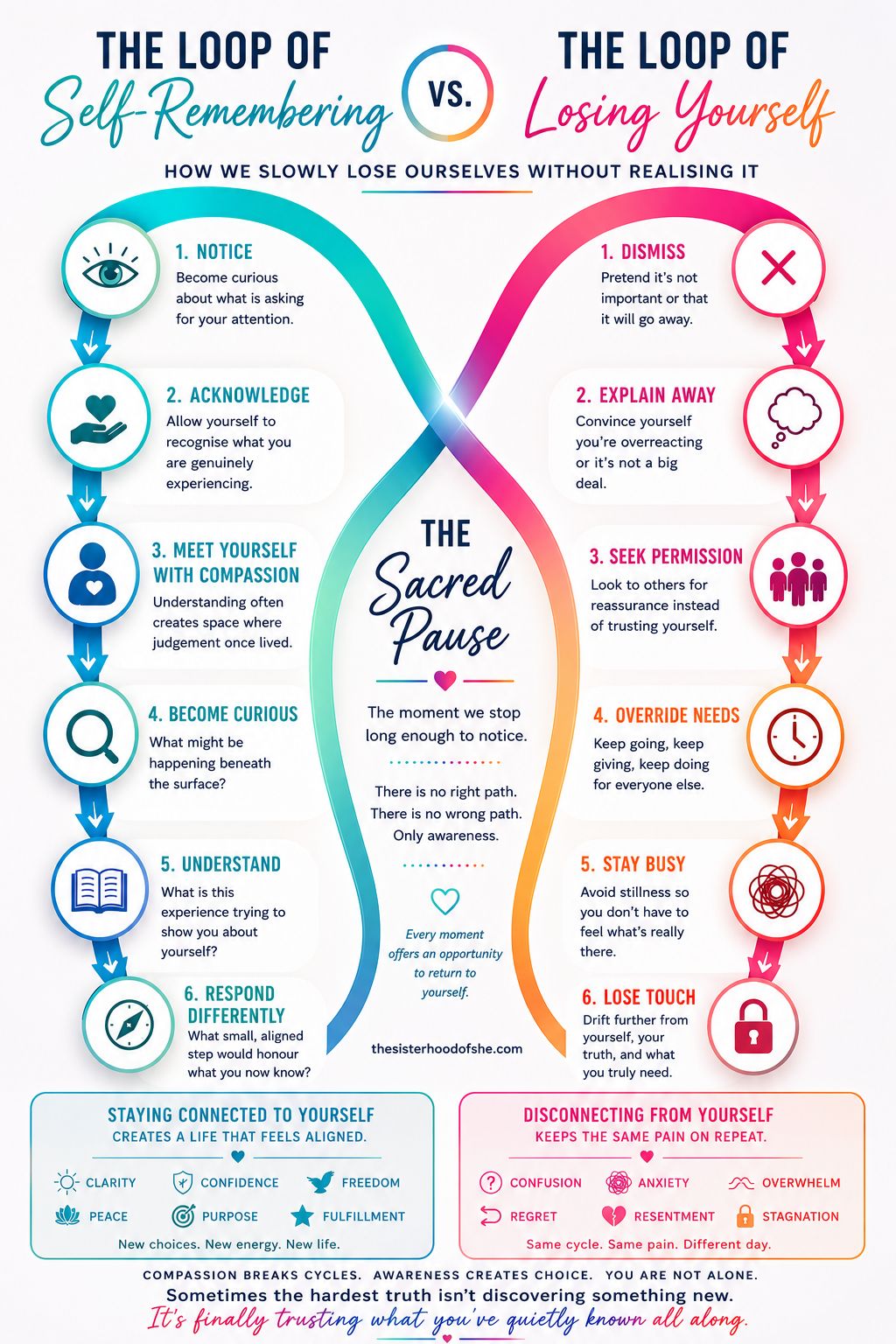
Which made us wonder whether we were always searching for answers. Or whether sometimes we were searching for permission.
The Difference Between Knowing And Trusting
This is where the conversation began taking an unexpected turn.
Which made us wonder whether we were always searching for answers, or whether sometimes we were searching for permission.
Perhaps honesty isn't always the challenge. Perhaps trusting what we know is.
If a friend tells us she's overwhelmed, most of us instinctively believe her. We don't immediately start questioning whether she's justified in feeling that way or suggest she spend the next six months gathering additional evidence before reaching a conclusion.
We certainly don't recommend assembling a small committee of trusted advisors to determine whether her exhaustion is real.
Yet when it comes to ourselves, many of us seem surprisingly willing to do exactly that, turning our feelings over from every possible angle while searching for confirmation of something we may have quietly known all along.
The more we noticed this, the more curious we became. Why do we find it easier to trust someone else's experience than our own? Why do we so often explain away what we feel? Why do we spend so much energy gathering reassurance for things we may already know?
And perhaps the most interesting question of all is why acknowledging something often feels harder than recognising it.
A Different Way Of Looking At It
The more we sat with that question, the more we wondered whether we sometimes judge ourselves too harshly for not acknowledging things sooner.
It's easy to look back with hindsight and ask why we didn't listen, why we didn't trust ourselves, or why we kept carrying on when part of us already knew something wasn't quite right. But perhaps there is another way of looking at it.
Perhaps that space between knowing and admitting isn't always resistance. Perhaps there are times when a part of us recognises a truth long before we're emotionally ready to hold it fully. After all, acknowledging something often changes our relationship with it.
Once we admit we're exhausted, we may have to face the possibility that we've been asking too much of ourselves for too long. Once we acknowledge we're unhappy, we may find ourselves confronting questions we'd rather avoid. Once we recognise that something has come to an end, we may have to make room for grief, disappointment or uncertainty.
The more we reflected on this, the more we realised that perhaps we aren't always avoiding the truth as much as we think we are. Sometimes we may simply be moving towards it at the pace we are able to. Sometimes life is quietly preparing us to see something before we are ready to fully embrace it.
And when we look at it that way, that space between knowing and admitting begins to feel a little less like failure and a little more like part of the human experience.
The Quiet Ways Life Speaks
As our conversations continued, we found ourselves becoming increasingly curious about something else.
How do we know in the first place?
It's an interesting question when you really stop and think about it.
Because most of us can remember moments where we knew something before we could explain it. We sensed something shifting. We felt uncomfortable in a situation that looked perfectly fine on paper. We found ourselves repeatedly drawn towards something without fully understanding why. Then months or years later, we look back and realise that what eventually became obvious had been quietly present all along.
Perhaps that is why so many of life's significant turning points rarely arrive with flashing neon signs or detailed instruction manuals. More often they seem to begin with something much quieter. A feeling that lingers longer than we expect it to. A conversation that stays with us for reasons we can't quite explain. A longing that keeps returning whenever life becomes still enough for us to notice it.
Looking back, we've both had experiences like that. Things that made very little sense at the time, yet somehow continued tapping us on the shoulder until we were finally willing to pay attention.
Which raises another interesting question.
What is it that notices these things in the first place?
Because there often seems to be a part of us quietly paying attention beneath the surface of everyday life. A part that recognises when something feels aligned and when it doesn't. A part that notices when we're moving towards ourselves and when we're moving away.
We don't really know what to call that part. Some people might describe it as intuition. Others might call it wisdom, instinct, awareness, experience, or simply a deep inner knowing. The name itself feels less important than the recognition that most of us have encountered it at some point in our lives.
It's the part that keeps returning us to the same feeling, question, conversation, or longing until eventually we're willing to listen.
And perhaps that is what makes this conversation about honesty so interesting.
Because maybe many of us are not waiting to discover the truth.
Maybe we're learning how to trust what has been quietly trying to reach us all along.
What If Honesty Isn't The Problem?
At some point during these conversations, we found ourselves looking at the question from a completely different angle.
What if we've been blaming honesty for something that doesn't really belong to honesty at all?
For years, both of us probably assumed that honesty was mostly about courage. The ability to face something difficult. The willingness to acknowledge what is true even when it feels uncomfortable.
And there is certainly some truth in that.
Yet when we look back at the moments that took us the longest to admit to ourselves, courage doesn't always seem to be the whole story.
More often, there was already a quiet knowing present somewhere in the background. We sensed what was happening. We felt it. We recognised it. The difficulty wasn't always seeing it. The difficulty was trusting ourselves enough to listen.
Sometimes that knowing was asking us to question something familiar. Sometimes it was asking us to acknowledge something painful. Sometimes it was inviting us towards a different path entirely. Whatever form it took, there often seemed to be a gap between recognising what was true and feeling ready to trust it.
Perhaps that is why there can be such a sense of relief when we finally acknowledge something we've known for a very long time.
When we look back, the relief rarely comes from discovering something new. More often it comes from finally putting down the exhausting internal debate. The negotiating. The explaining. The endless attempts to convince ourselves that what we feel isn't real, isn't valid, or isn't important enough to pay attention to.
At some point, the argument simply ends.
And there is something surprisingly freeing about that.
Looking back at our own lives, we've found ourselves feeling a great deal more compassion for the parts of us that weren't ready yet. Not because they were weak or avoiding life, but because perhaps they were moving as carefully as they knew how. Perhaps they were waiting until they felt safe enough to trust what they already knew.
Which leaves us with a different question altogether.
Instead of asking why we struggle to be honest with ourselves, perhaps the more interesting question is what might change if we trusted ourselves a little more.
Because when we look back, many of the things that eventually changed our lives weren't sudden discoveries. More often, they were things we had quietly known for a very long time.
Perhaps that is why there can be such a sense of relief when we finally acknowledge them.
The relief doesn't seem to come from discovering something new. It comes from no longer having to argue with ourselves about what we already know.
And there is something surprisingly freeing about that.
The Conversation Continues
If this conversation resonated with you, we'd love to hear from you.
Have you ever looked back and realised you knew something long before you were ready to admit it?
One of the things we love most about The Sisterhood of SHE is hearing the reflections, stories, and insights shared by the women in this community. If something in this article sparked a thought, a memory, or a new awareness, feel free to reach out and share it with us.
You can email us anytime at support@thesisterhoodofshe.com.
We read every message and genuinely love hearing from you.
For the moments you need to feel a little more like yourself again.
The Sisterhood of SHE